ReloPortal Redesign
Phase 1: Scope and Research
ReloPortal Redesign
Phase 1: Scope and Research
ReloPortal Redesign
Phase 1: Scope and Research
Enterprise AI Decision Advisor
Designing an explainable AI-assisted experience for enterprise access reviews,
risk assessment, and human-controlled decisions.
Independent concept | Synthetic data | Prototype in development
A proposed AI decision-support experience for evaluating access risks, explaining recommendations, and keeping administrators in control.

A conceptual AI-assisted decision-support experience designed to identify potential access risks, explain recommendations,
and help administrators make informed decisions while maintaining human oversight.
AI Product Strategist | Enterprise AI & Decision Support
Platforms: Enterprise SaaS, Generative AI, Workflow Automation, Responsible AI
Overview
Enterprise administrators often manage complex relationships between people, organizations, applications, roles, and permissions.
This independent project investigates how AI-assisted analysis can make those relationships easier to understand,
surface potential access risks, and support more informed decisions without removing human accountability.
The Challenge
Access management can require administrators to interpret fragmented information, compare user responsibilities against assigned permissions, and determine whether access remains appropriate. Traditional interfaces provide the underlying data but may offer limited guidance when evaluating complex or unusual situations. The design challenge is to explore how AI can provide useful explanations and recommendations
while maintaining accuracy, transparency, and administrative control.
Role & Approach
As an independent AI Product Strategist and Experience Designer, I am defining the business opportunity, mapping the decision workflow, designing the interaction model, and developing a functional prototype. The approach combines enterprise UX, structured policy evaluation, generative AI, and human-in-the-loop controls. Synthetic data and defined test scenarios will be used
to evaluate the experience without relying on proprietary client information.
AI Opportunity Assessment
The initial opportunity focuses on access reviews, where administrators must determine whether assigned permissions
align with a user's responsibilities. The proposed solution combines structured access rules with AI-generated explanations
to highlight potential inconsistencies and recommend further review. The goal is to reduce interpretation effort
and improve decision clarity, rather than automate permission changes without approval.

Proposed opportunity model identifying workflow friction, potential AI interventions,
expected value, and implementation risks.
Decision Workflow & Risk Model
The proposed workflow begins with selecting an organization and reviewing its access records.
Defined policy rules identify potential conflicts, while an AI assistant translates relevant findings into understandable explanations. Administrators can inspect the evidence, request clarification, and approve, reject, or defer recommended actions. The experience is designed to distinguish verified system data from generated interpretation.

Conceptual decision workflow connecting policy checks, AI explanations, risk indicators, and human approval.
Designing the AI Experience
The interface is being designed around three priorities: making complex information understandable, showing why recommendations are made, and keeping people responsible for consequential decisions. Proposed patterns include contextual risk indicators, evidence panels, conversational explanations, clear action states, and confirmation steps.
The aim is to make AI assistance useful within an existing administrative workflow
rather than introducing a disconnected chatbot experience.

Proposed experience patterns for reviewing access, examining evidence, and making informed administrative decisions.
Building the Prototype
The planned prototype will use fictional dealership organizations, user records, product permissions, and access policies to demonstrate an end-to-end review. Deterministic checks will identify defined policy exceptions, while an AI model will be used to explain findings and respond to questions. Proposed actions will require explicit human approval, with activity captured in a simulated audit history. The technical implementation and model behavior will be documented as development progresses.

Planned prototype architecture separating structured access data, policy evaluation, AI-generated explanations, a
nd human-controlled actions.
Responsible AI & Evaluation
The evaluation plan will focus on recommendation accuracy, explanation quality, evidence traceability, usability,
and the effectiveness of human oversight. Test scenarios will include valid access, unnecessary permissions,
conflicting assignments, incomplete information, and ambiguous requests. The design will also examine
how the system communicates uncertainty and avoids presenting AI-generated conclusions as verified facts.

Proposed evaluation framework covering decision quality, explainability, uncertainty, and human control.
Outcomes & Reflection
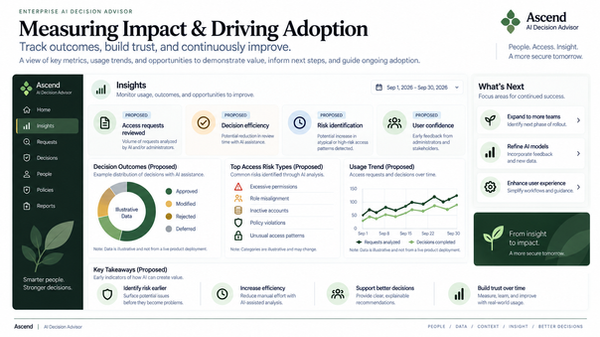
This project is currently in development. Its intended outcome is a working demonstration of how structured enterprise data, policy rules, and generative AI can support more understandable and accountable decisions.
Once the prototype is implemented and tested, this section will document observed behavior, limitations,
evaluation findings, and opportunities for improvement.